Insurance Company Digital Strategy
Leveraging large-scale user research to drive strategic design decisions.
Our client is one of the largest life insurers in Asia. For this project, they tasked us with envisioning their future digital strategy for the Greater China region, focusing on the design of a new consumer app.
As the Experience Design Expert, I led a large-scale user research initiative across nine major cities. I redesigned customer journeys for four distinct personas across multiple touchpoints to drive insurance sales and deliver high-quality service. Ultimately, I proposed a comprehensive information architecture and detailed solution design for the client's future digital products.
Project Overview
| Skills | Digital Strategy, User Research, Information Architecture, Wireframing & Interaction Design |
|---|---|
| Duration | 5 months |
| Industry | Insurance |
| My Roles | Experience Design Expert |
| Team Size | 5-7 people |
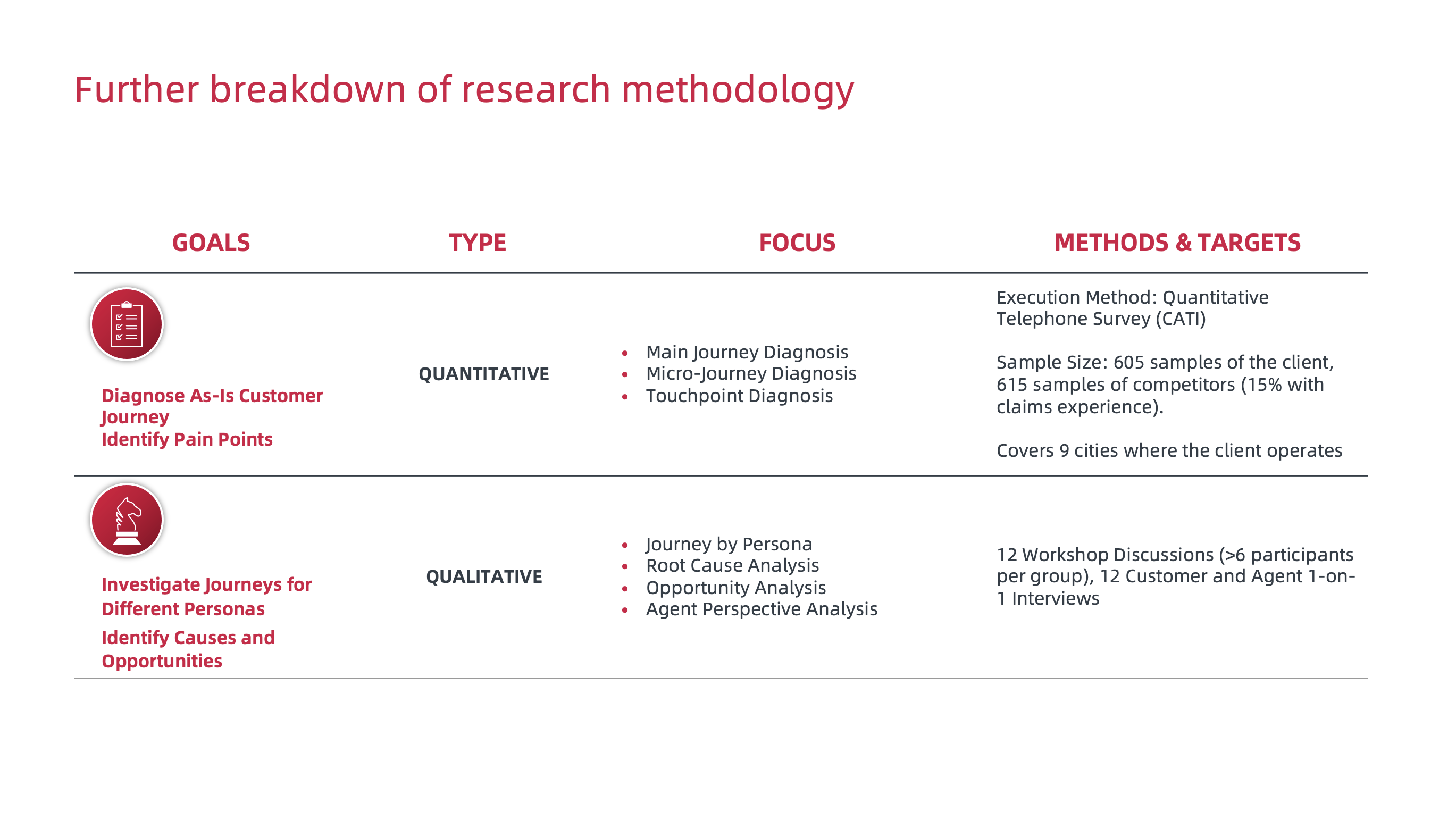
| Outcomes | 1. Gathered customer insights from over 1,200 surveys and 48 interview participants. |
- Redesigned customer journeys for four personas across multiple touchpoints to boost insurance sales and elevate service quality.
- Proposed a comprehensive information architecture and detailed solution design for the client's future digital products. |
Project Approach
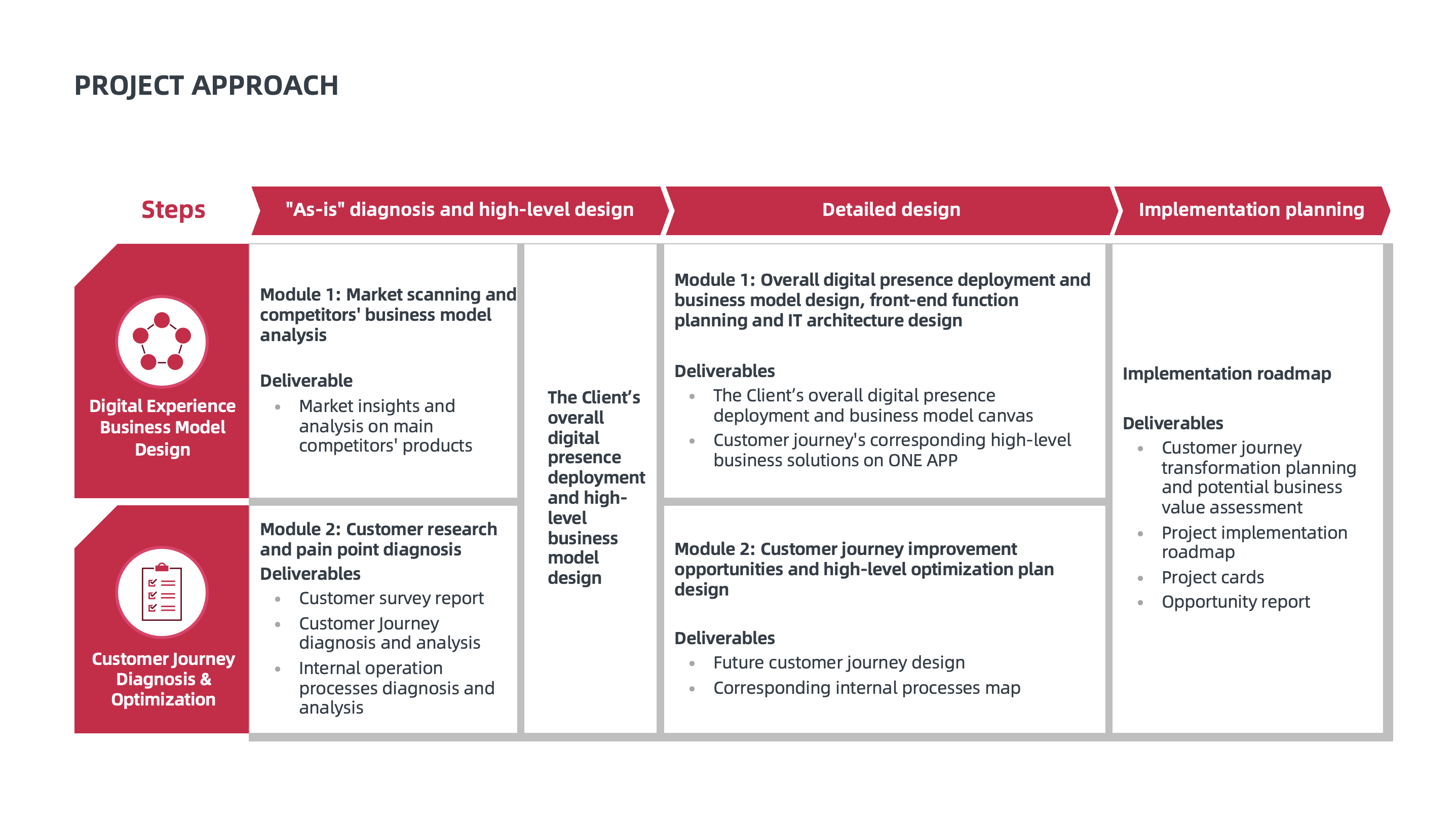
The project spanned four months and consisted of three key phases: "As-is" diagnosis and high-level design, detailed design, and implementation planning. The project approach is illustrated in detail below. My primary responsibility was the Customer Journey Diagnosis & Optimization module (Phases 1 & 2), which is the primary focus of this case study.
Phase 1: "As-Is" Diagnosis and High-Level Design
During this phase, we conducted thorough customer research to inform a high-level business model and design product features.
Research Methodology
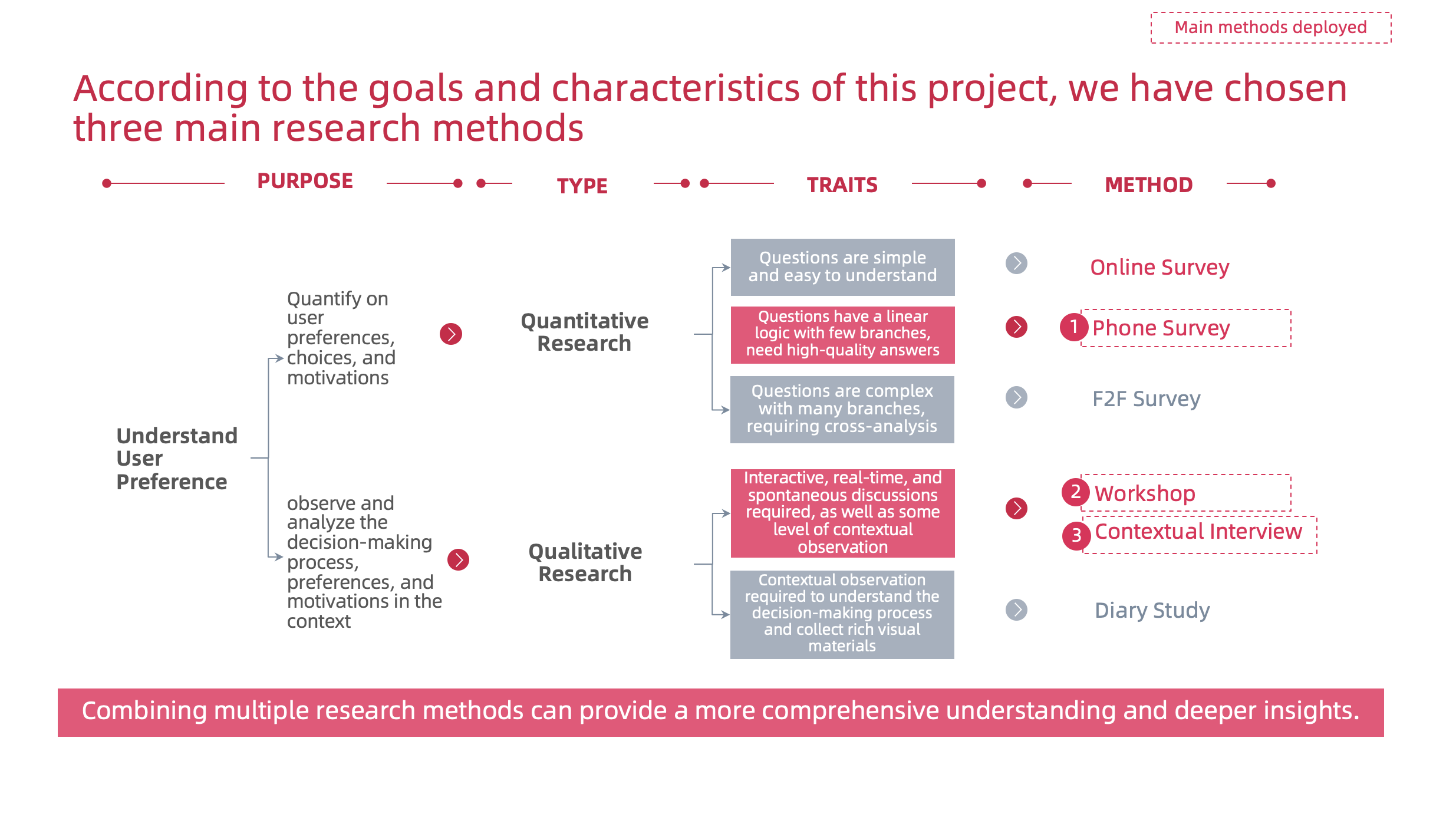
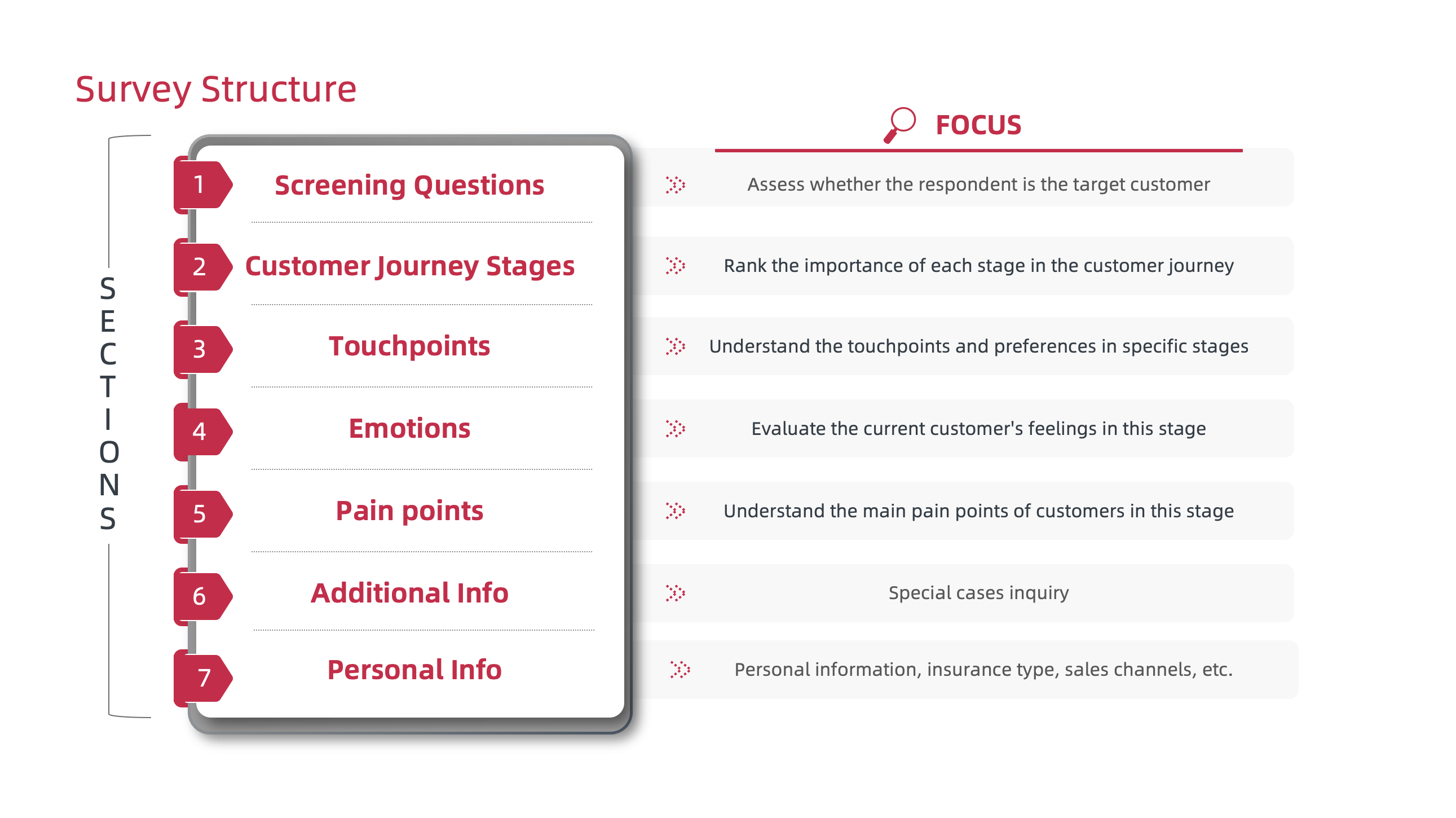
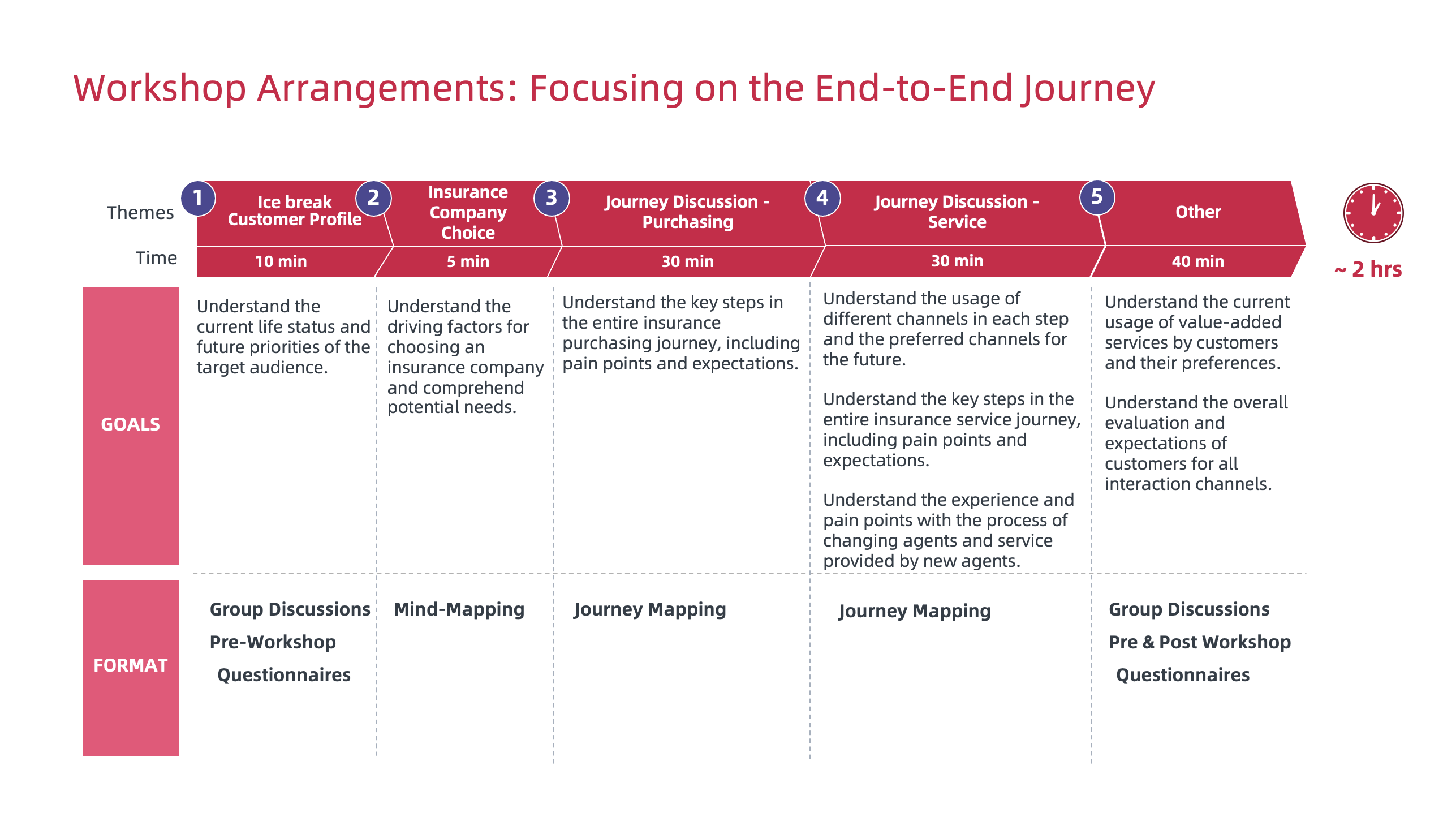
Considering the project goals, budget, and timeframe, we selected three main research methods: phone surveys for quantitative data, and workshops and contextual interviews for qualitative insights.
Research Planning & Execution
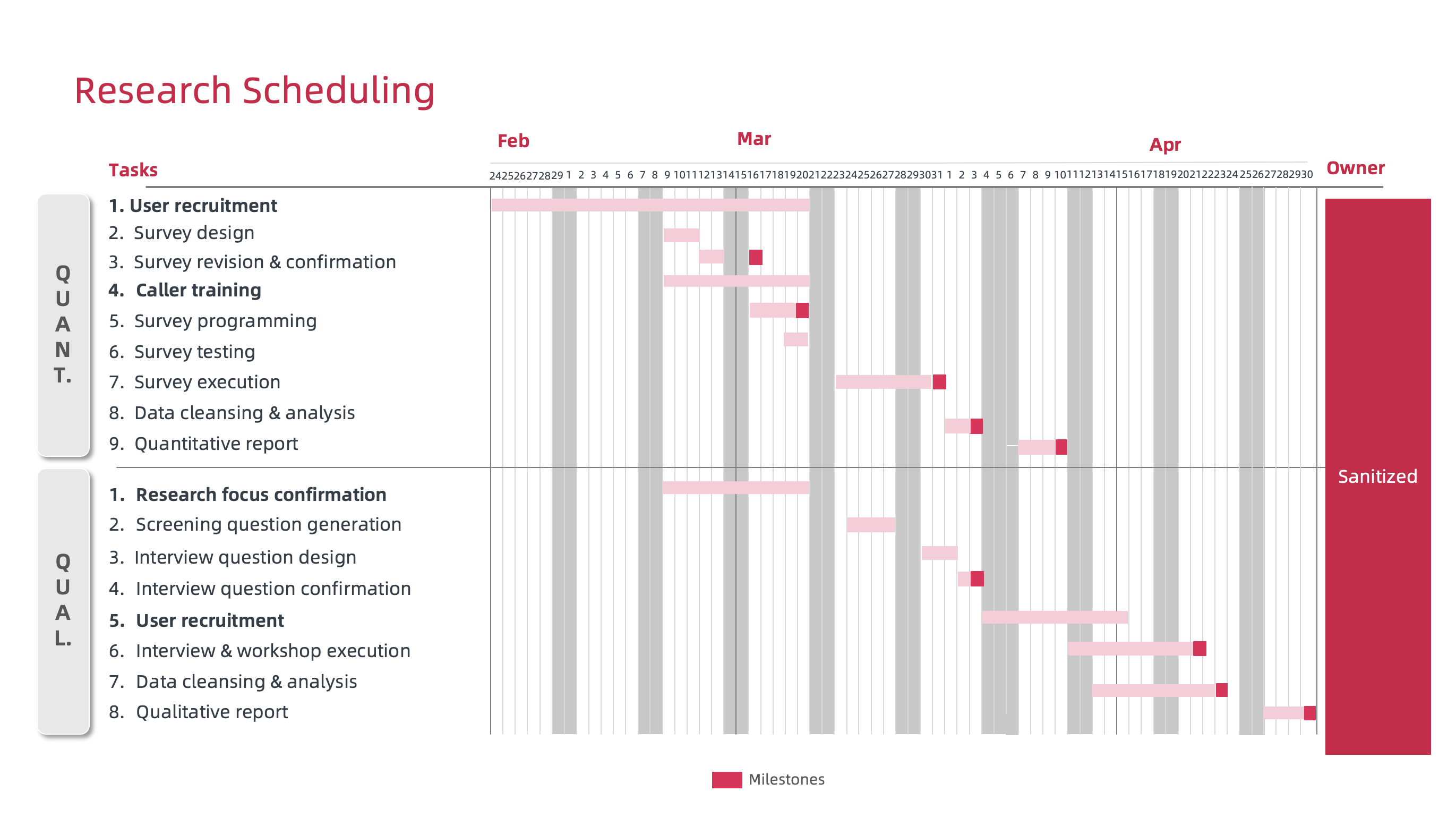
To execute the research plan efficiently and cost-effectively, we partnered with a third-party vendor for participant recruitment. I was responsible for vendor selection, research scheduling, and budget management. Additionally, I prepared all research materials, including the design of surveys and interview questions.
Customer Personas
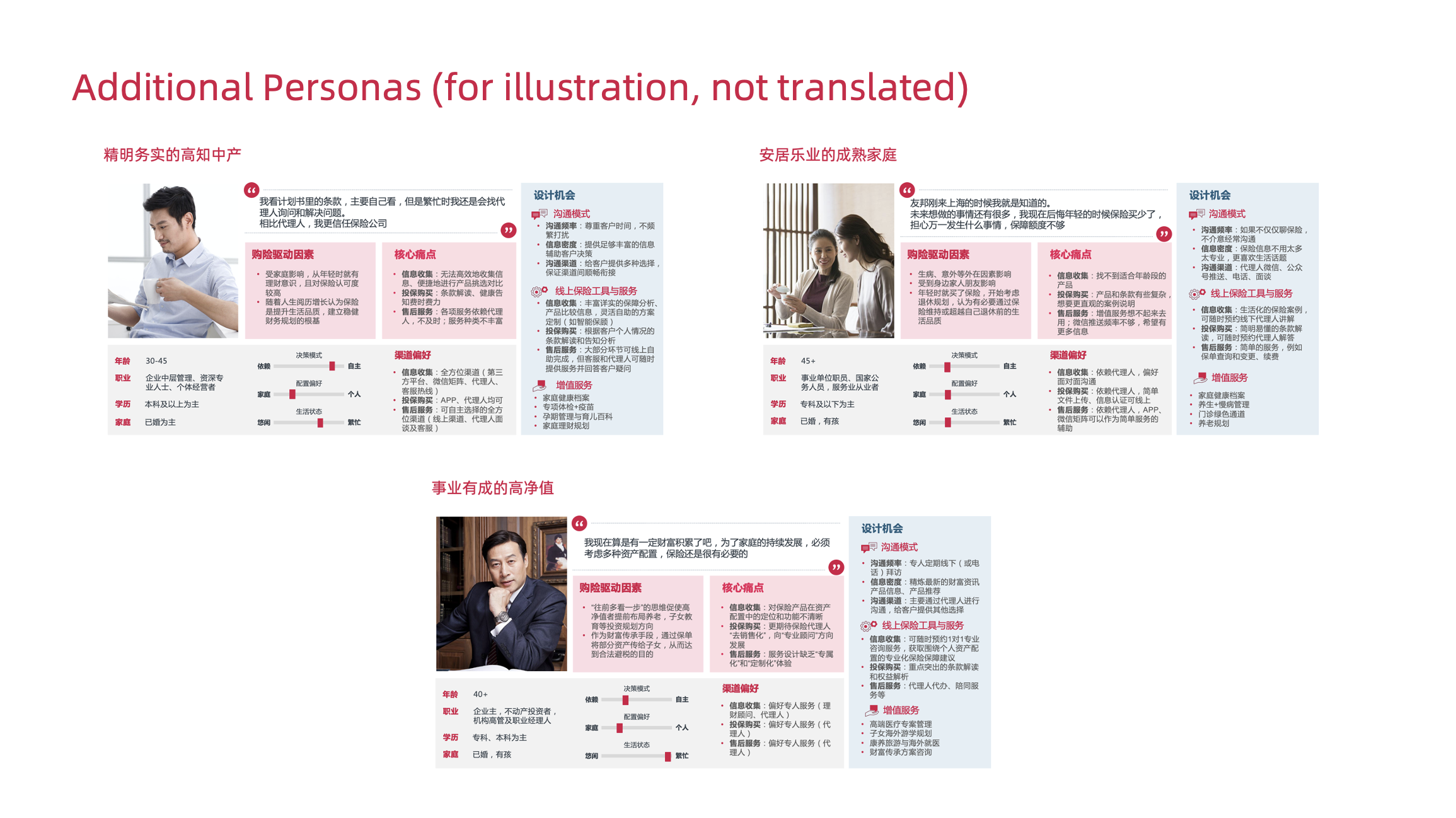
By consolidating findings from the phone surveys, contextual interviews, and workshops, we distilled five distinct customer personas: the Well-Educated Middle Class, the Established Family, the High Net-Worth Individual, the Aspiring Youth, and the Affluent Mass.
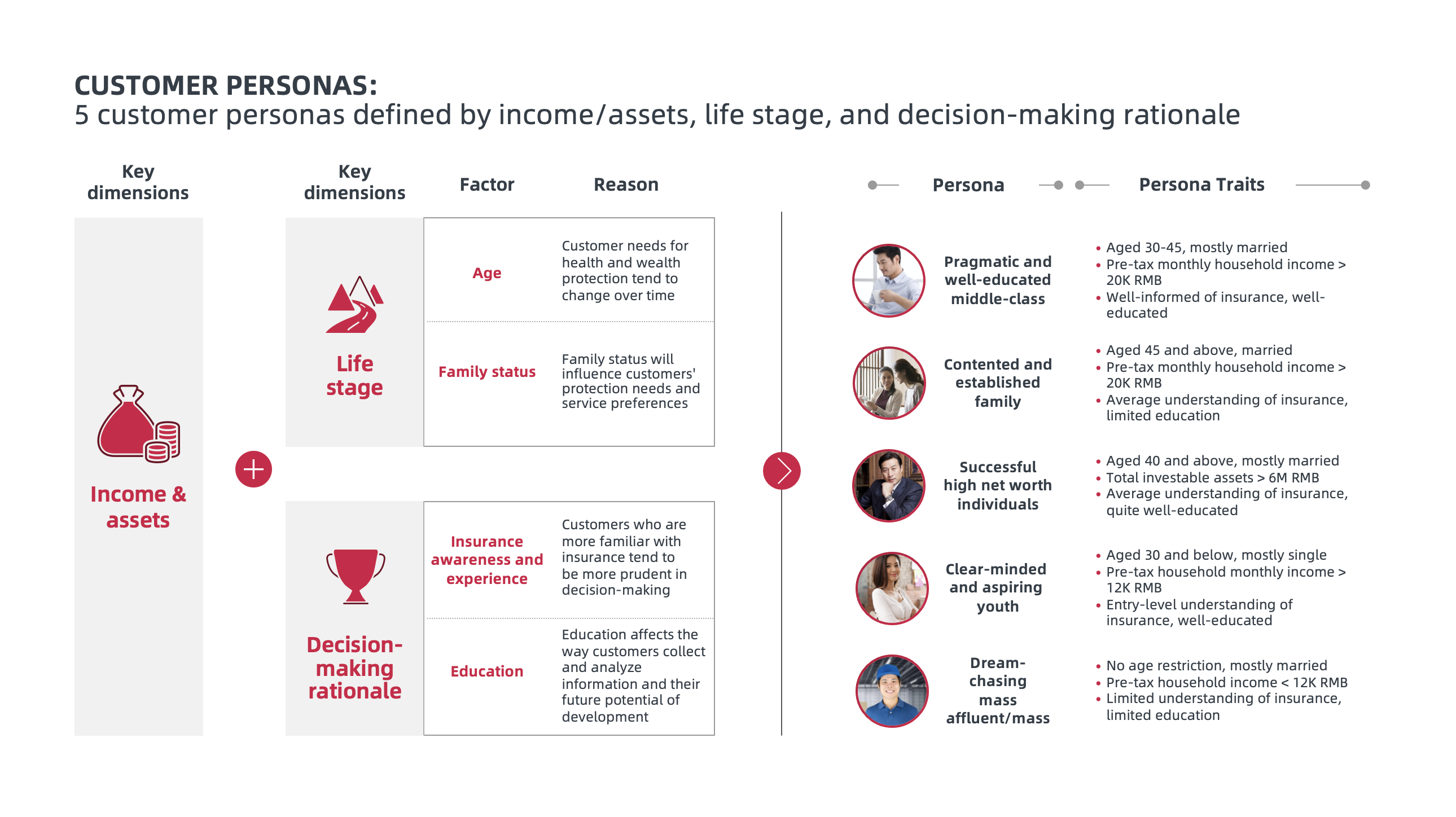
Based on the ratio of customer numbers and revenue contributions, we have identified four personas that will be the focus of our future strategy and product design.
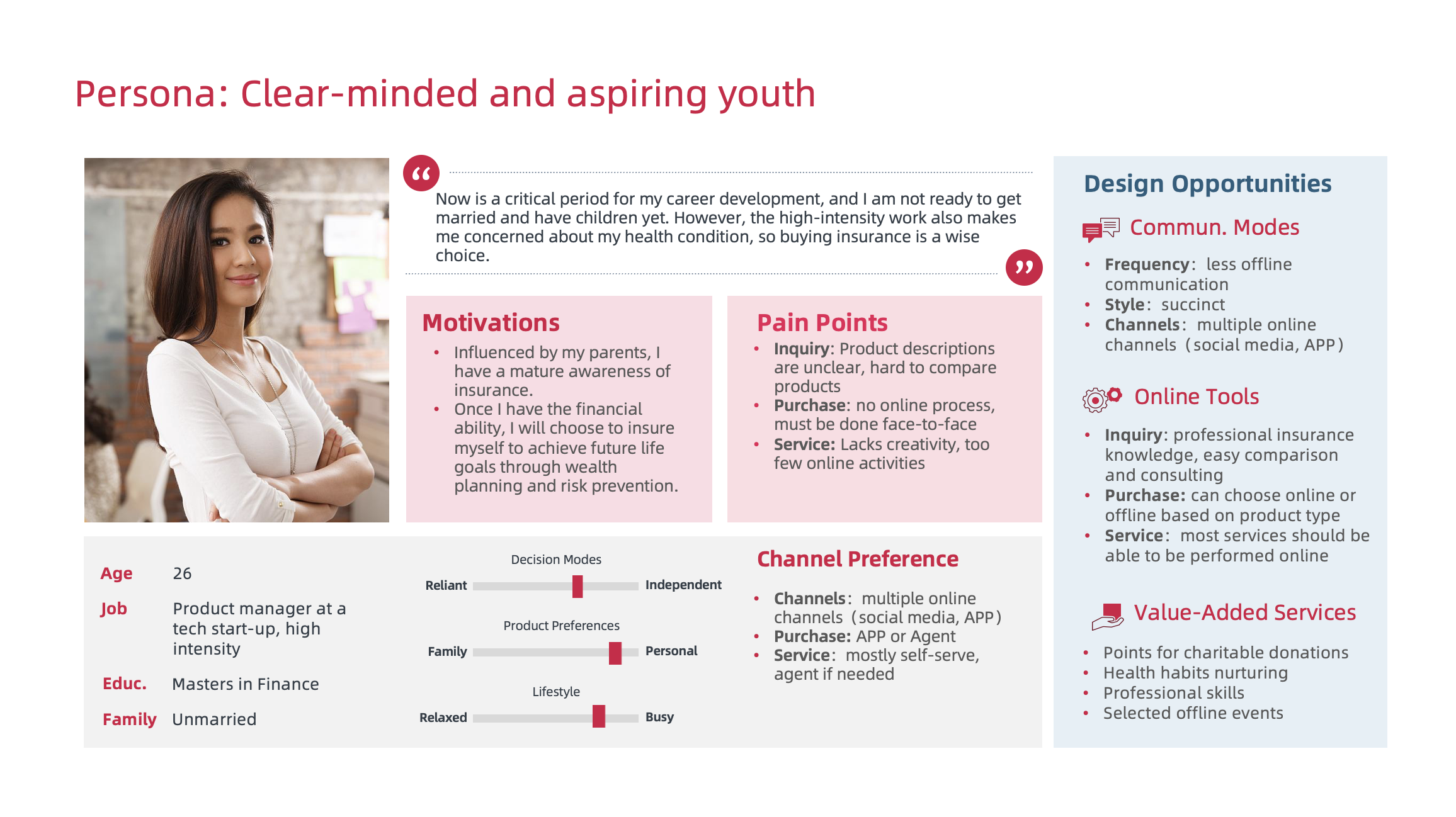
When creating the personas, we closely considered how they make decisions regarding insurance purchases and what online and offline resources they use when making those decisions. Additionally, we investigated their expectations regarding insurance services (self-service vs. agent service) and the value-added services they are looking for.
Below are some key insights we discovered during this stage:
- Aspiring Youth and the Well-Educated Middle Class personas generally prefer self-service as they tend to be busy with their daily work. They would normally do a lot of research before making a purchase. However, due to the lack of insurance-related knowledge of the Aspiring Youth persona, they usually need more assistance from agents during earlier stages of the journey.
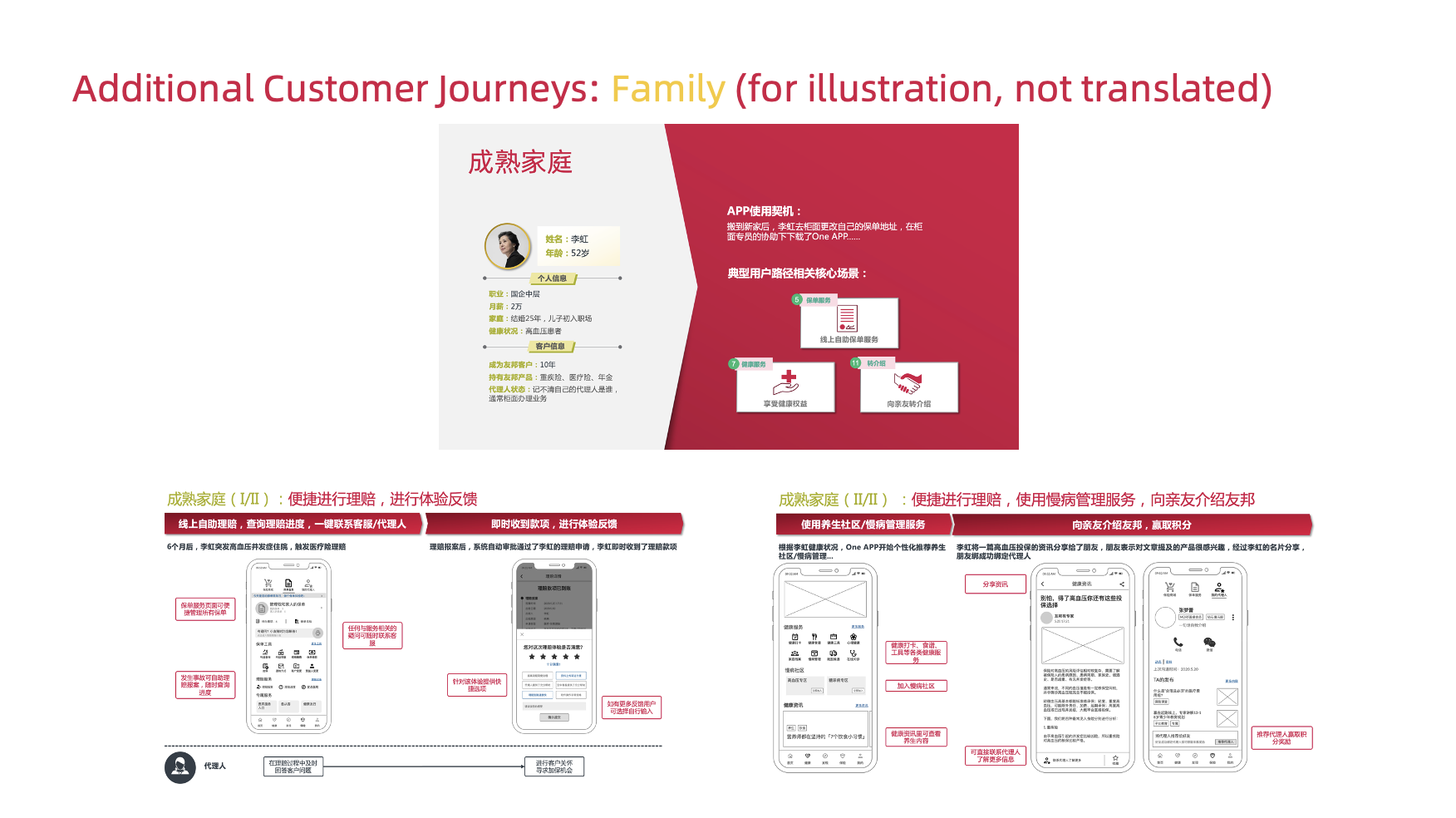
- The Mature Family persona prefers agent service instead of online service in almost all journey phases. Additionally, they want their agents to be their "friends", which means they expect frequent drop-ins and discussions on topics other than insurance.
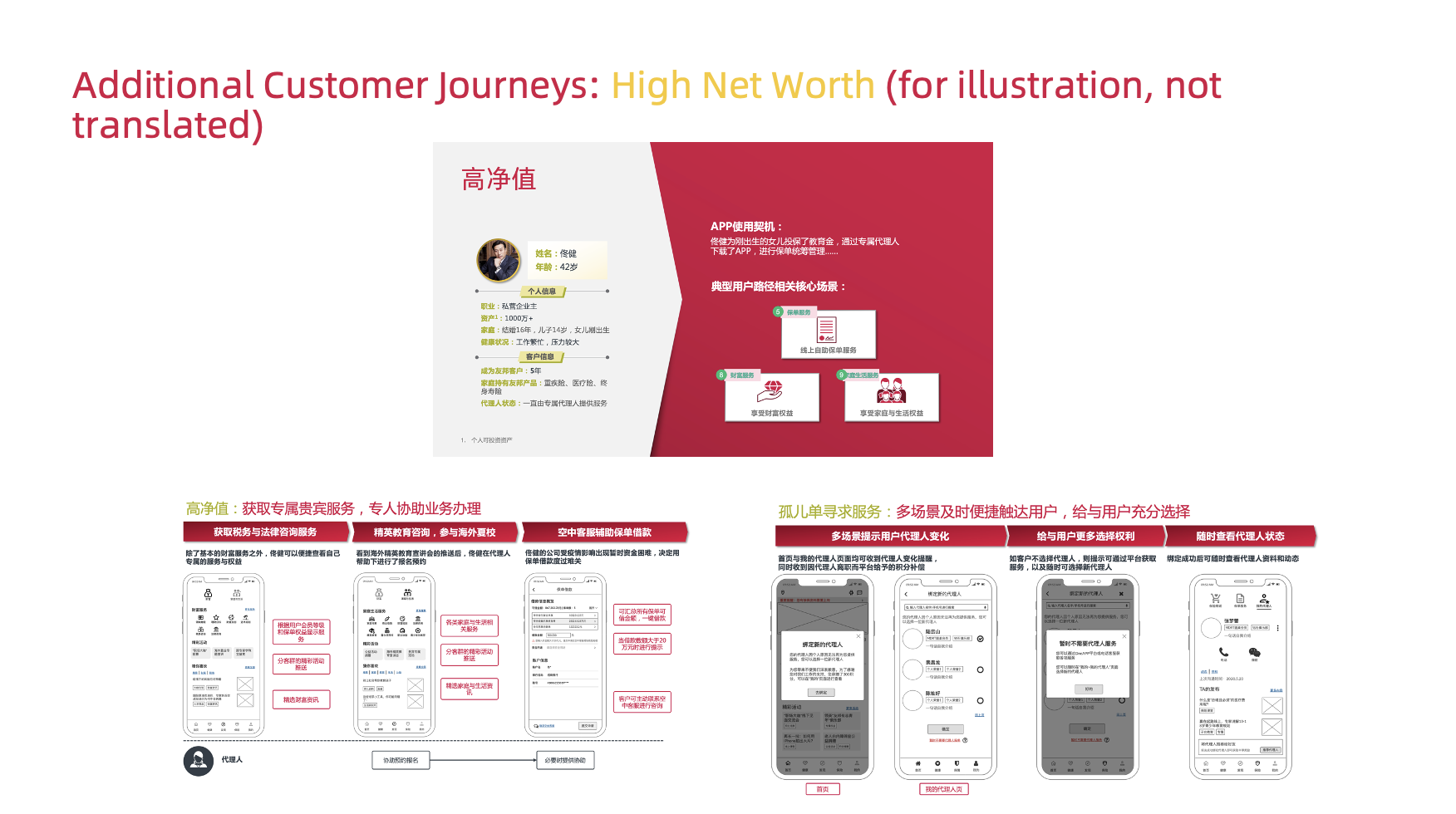
- High Net Worth individuals are extremely busy, and they require highly specialized service in topics such as wealth management and inheritance planning. They also prefer offline service.
Value Propositions & High-level Service Designs
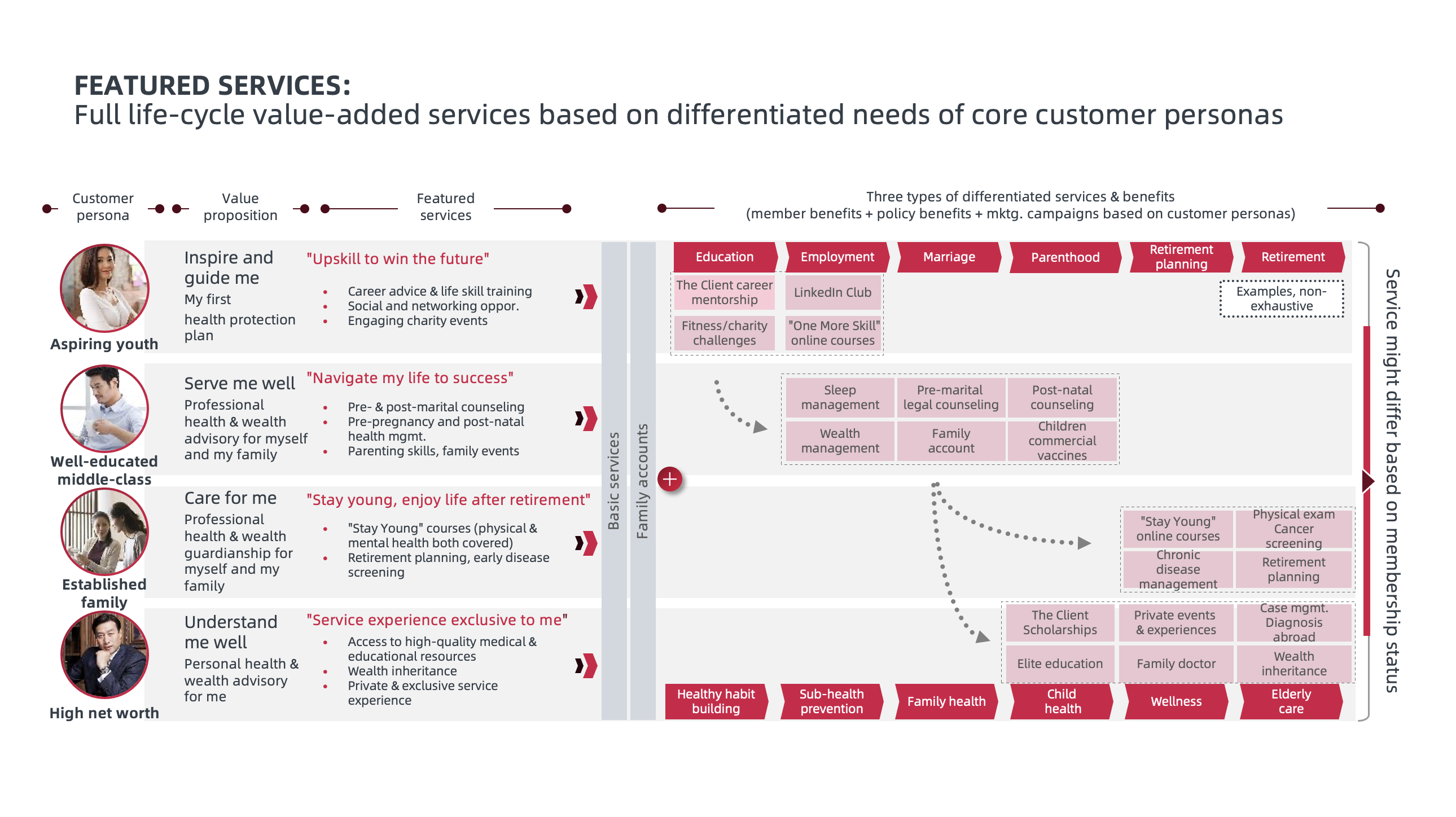
Based on the unique behaviors and preferences of each persona, we crafted tailored value propositions, as illustrated below:
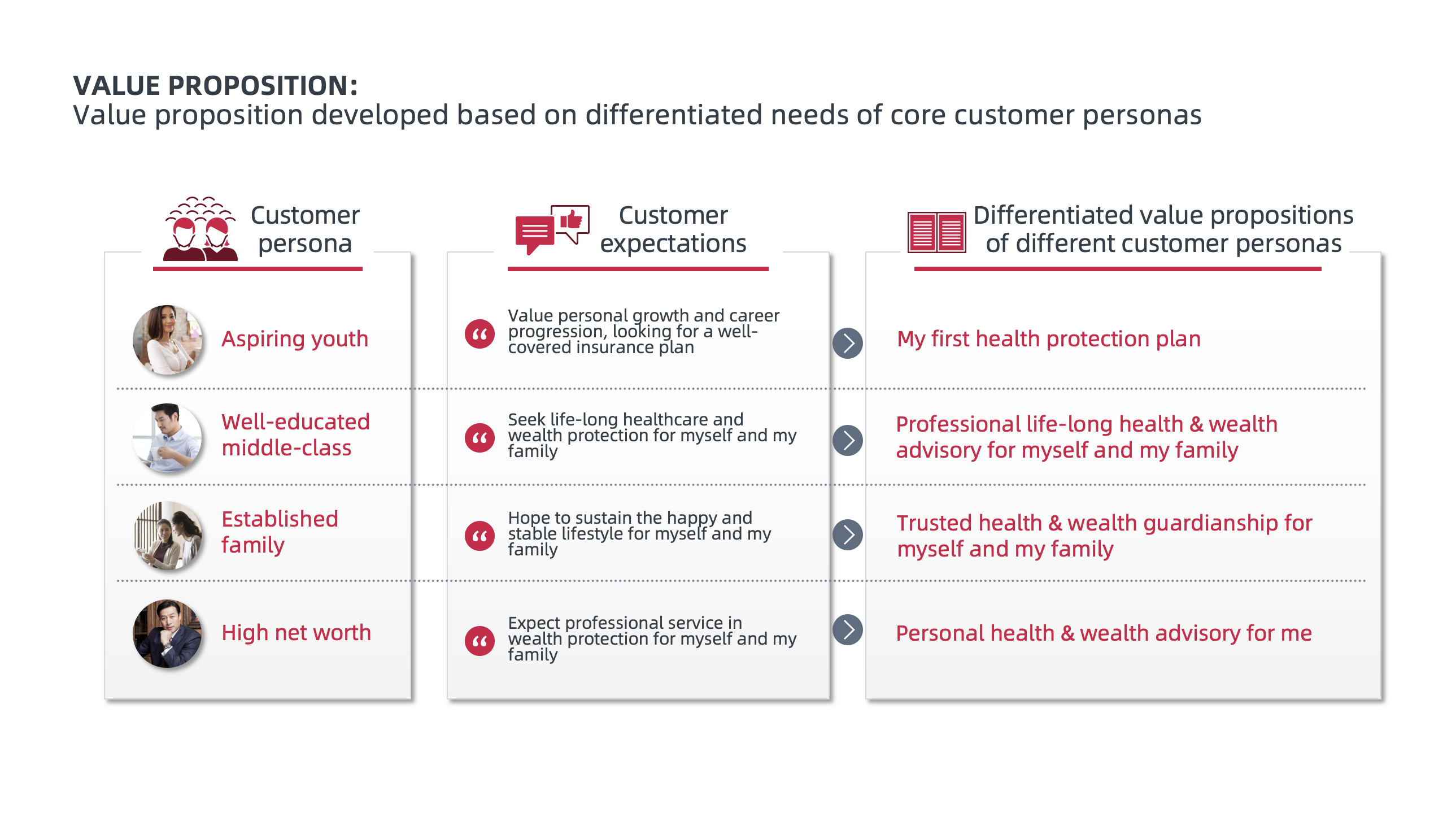
Building on these value propositions, we designed a customized service blueprint for each persona. These blueprints outline the differentiated services and digital features to be offered at every stage of the customer journey.
Taking the Aspiring Youth persona as an example, their key value proposition is "My first health protection plan." Consequently, their journey focuses on building insurance awareness via the app and third-party platforms. Furthermore, the strategy positions the client to support the professional and personal goals of the Aspiring Youth throughout their entire journey.
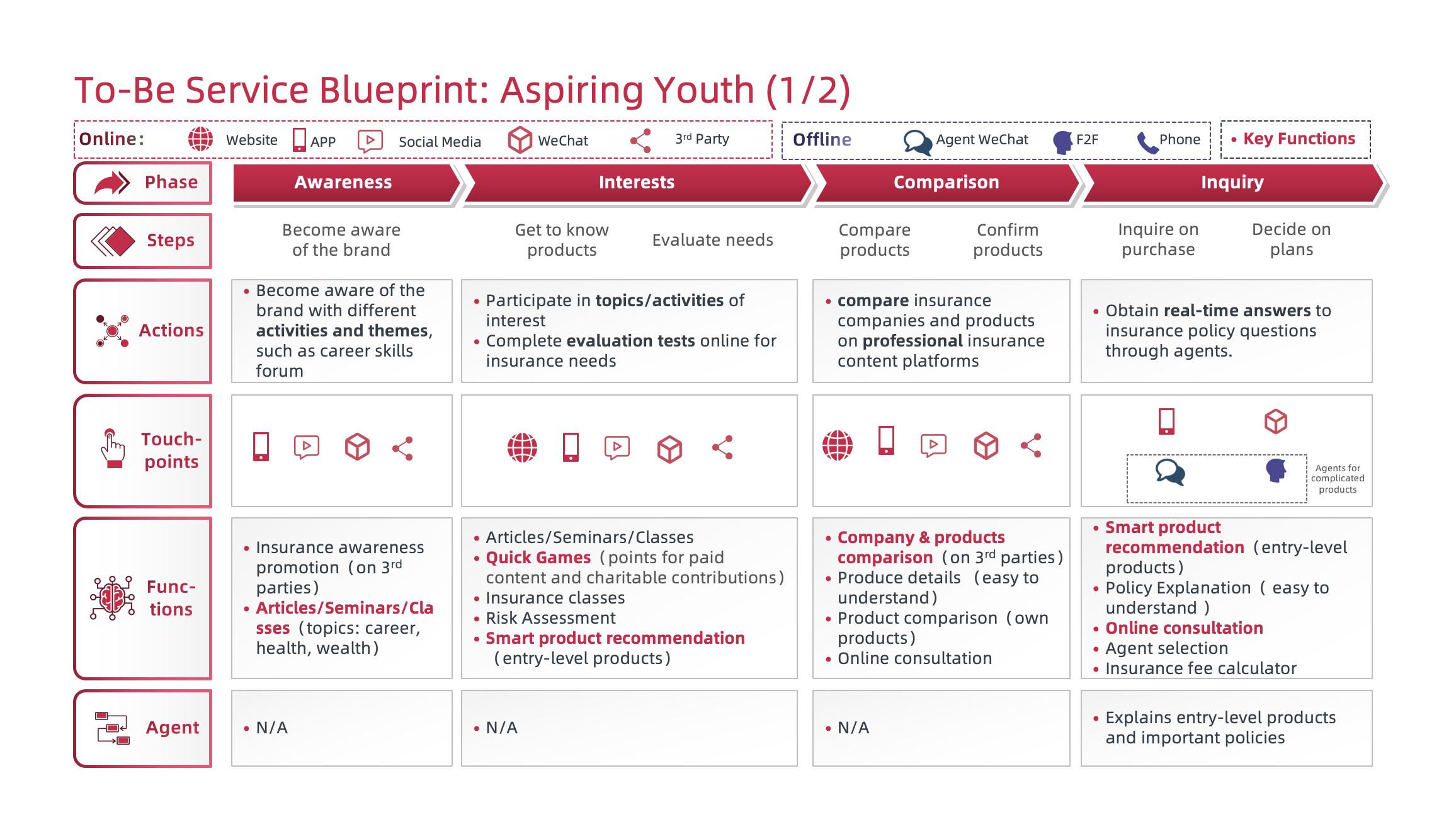
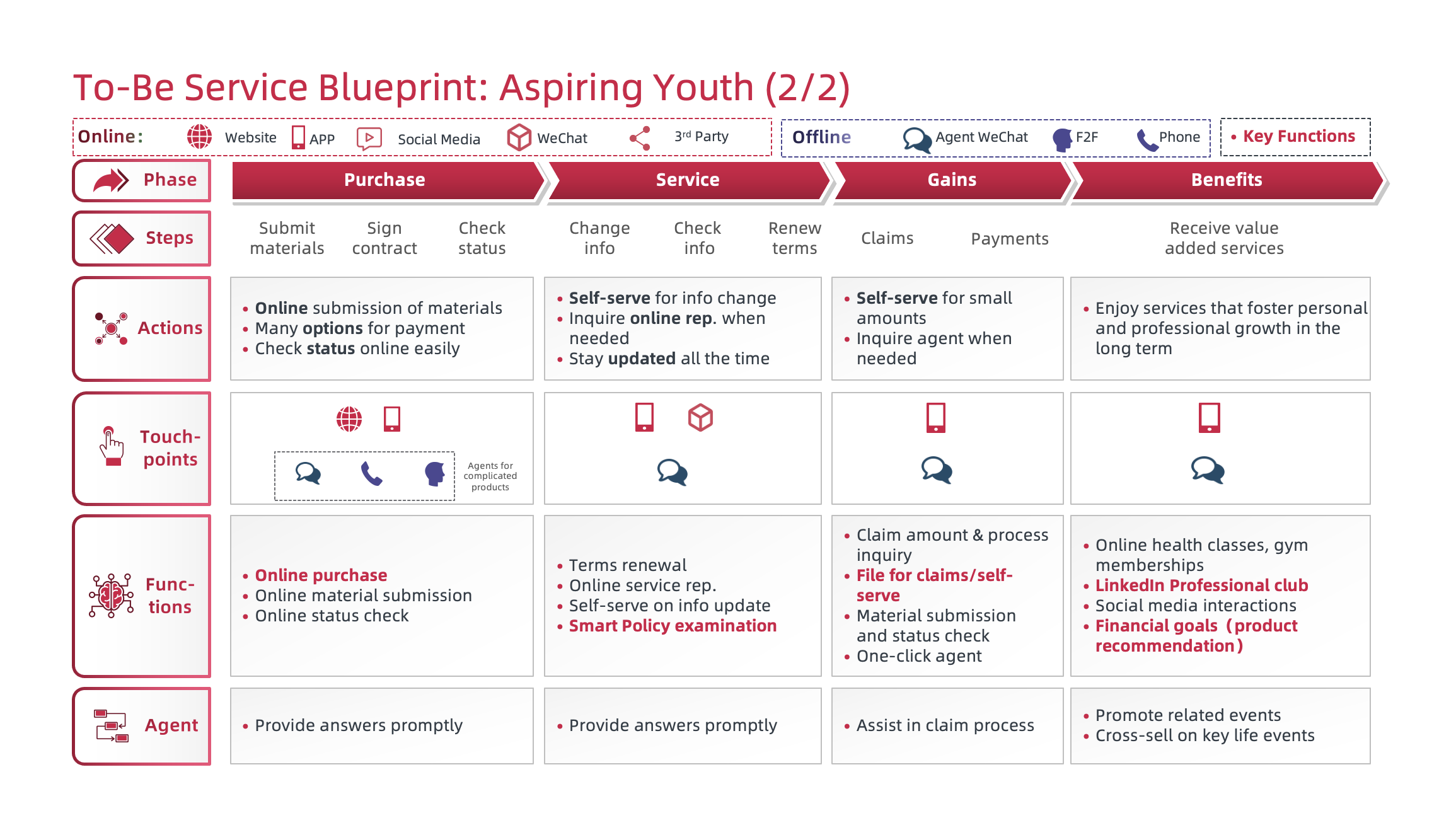
Because most of the client's products require a long-term commitment, offering value-added services—such as health consultations and wealth management—is crucial. Leveraging our user research, we envisioned a suite of full life-cycle value-added services designed around the specific needs of our core personas.
Phase 2: Detailed Product Design
During this phase, we translated our high-level strategy into detailed product designs, defining key use cases, information architecture, and wireframes.
Major App Use Cases
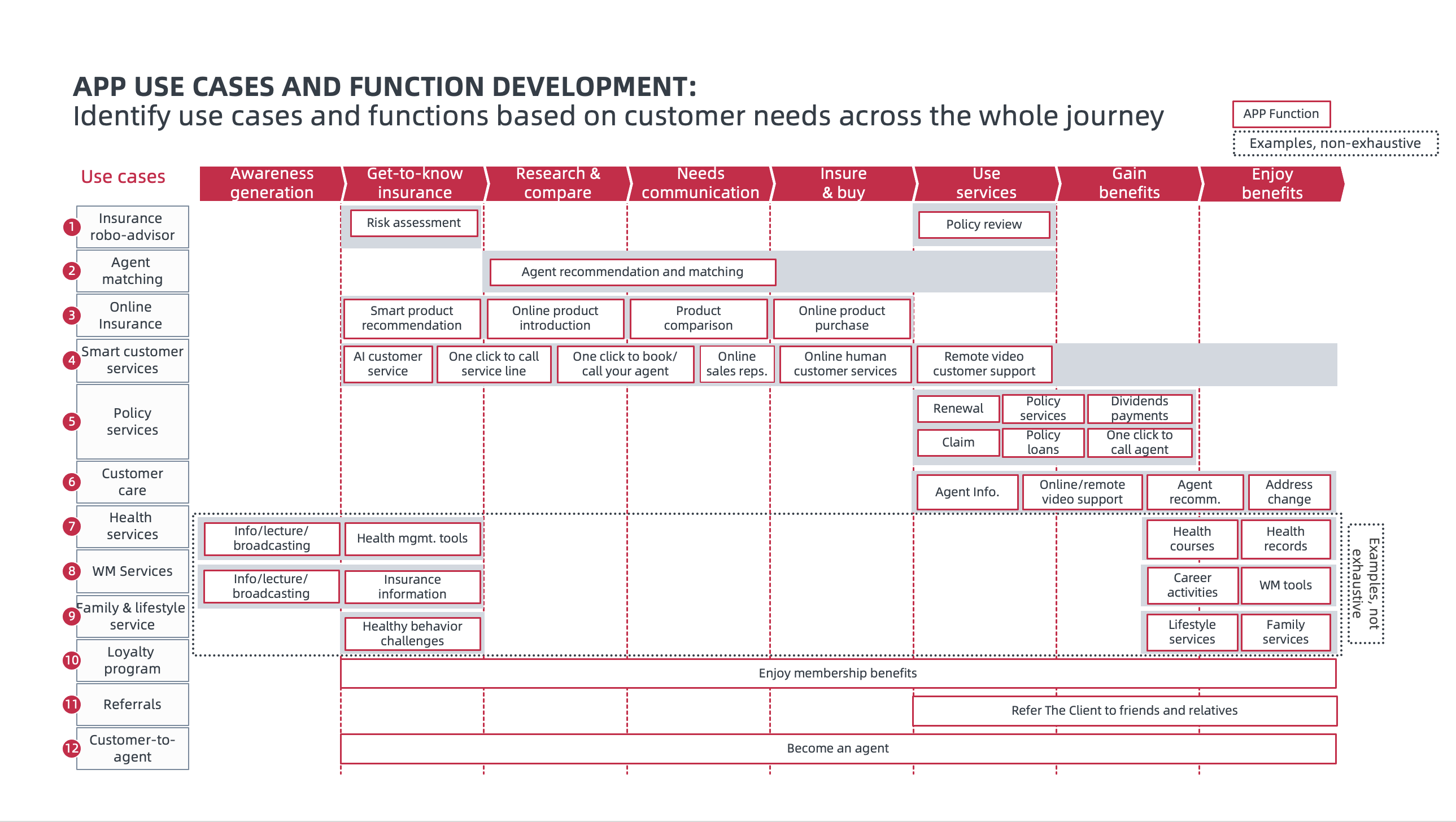
Based on our earlier analysis, we defined 12 key use cases and associated functions across the customer journey. These use cases were designed to significantly enhance the client's digital competitiveness while enabling seamless transitions between online and offline services for customers.
Digital App Information Architecture
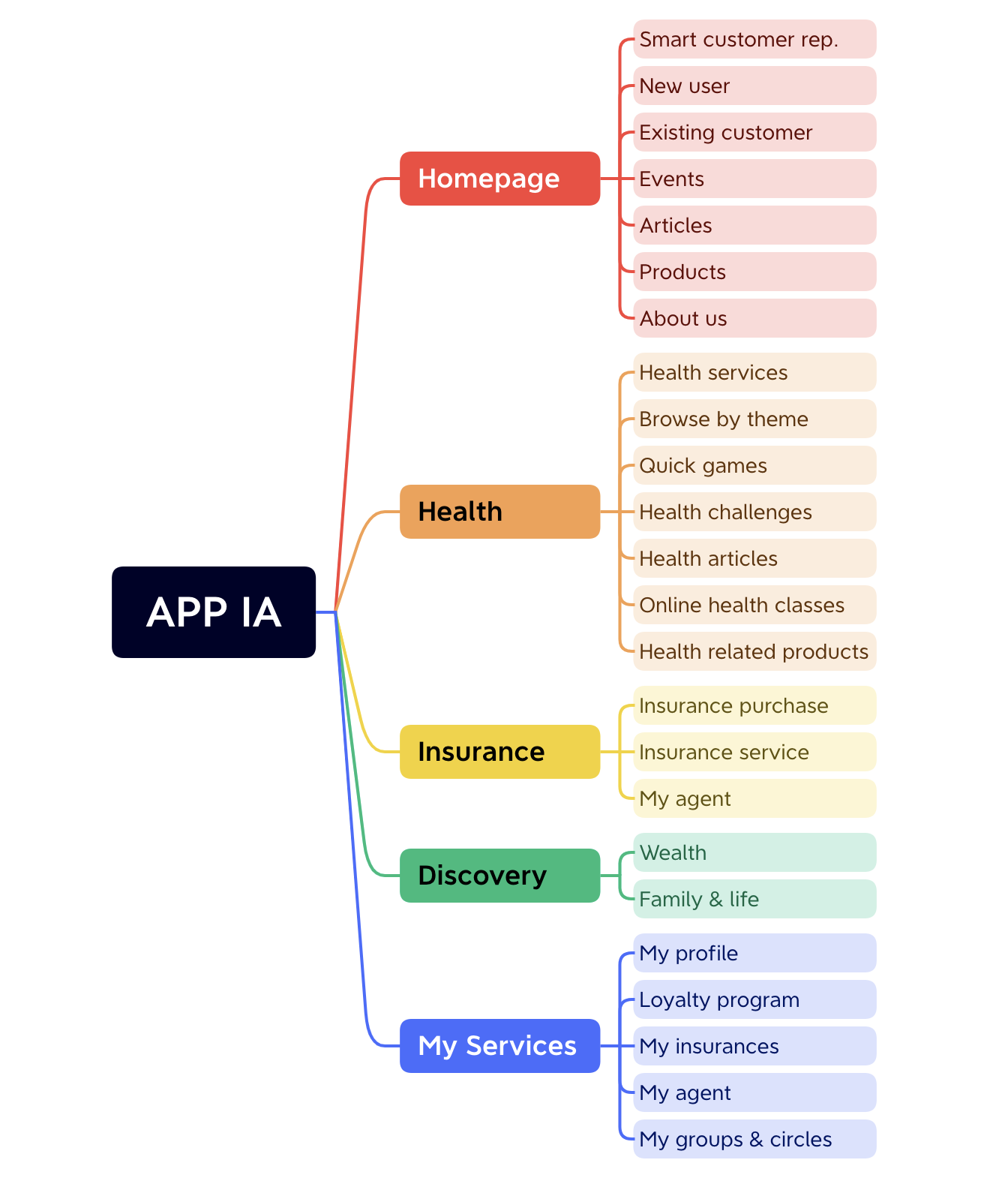
Next, we mapped out the information architecture for the future app. As the homepage serves as the primary entry point, it was critical to optimize this digital space. We designed a differentiated app experience based on user status (new vs. existing) to provide a more personalized journey.
Additionally, our research revealed that health was a top priority across all personas. In response, we introduced a dedicated tab for health-related information, events, and products, distinct from the 'Wealth' and 'Family & Life' categories within the Discovery tab.
Future Customer Flow by Persona
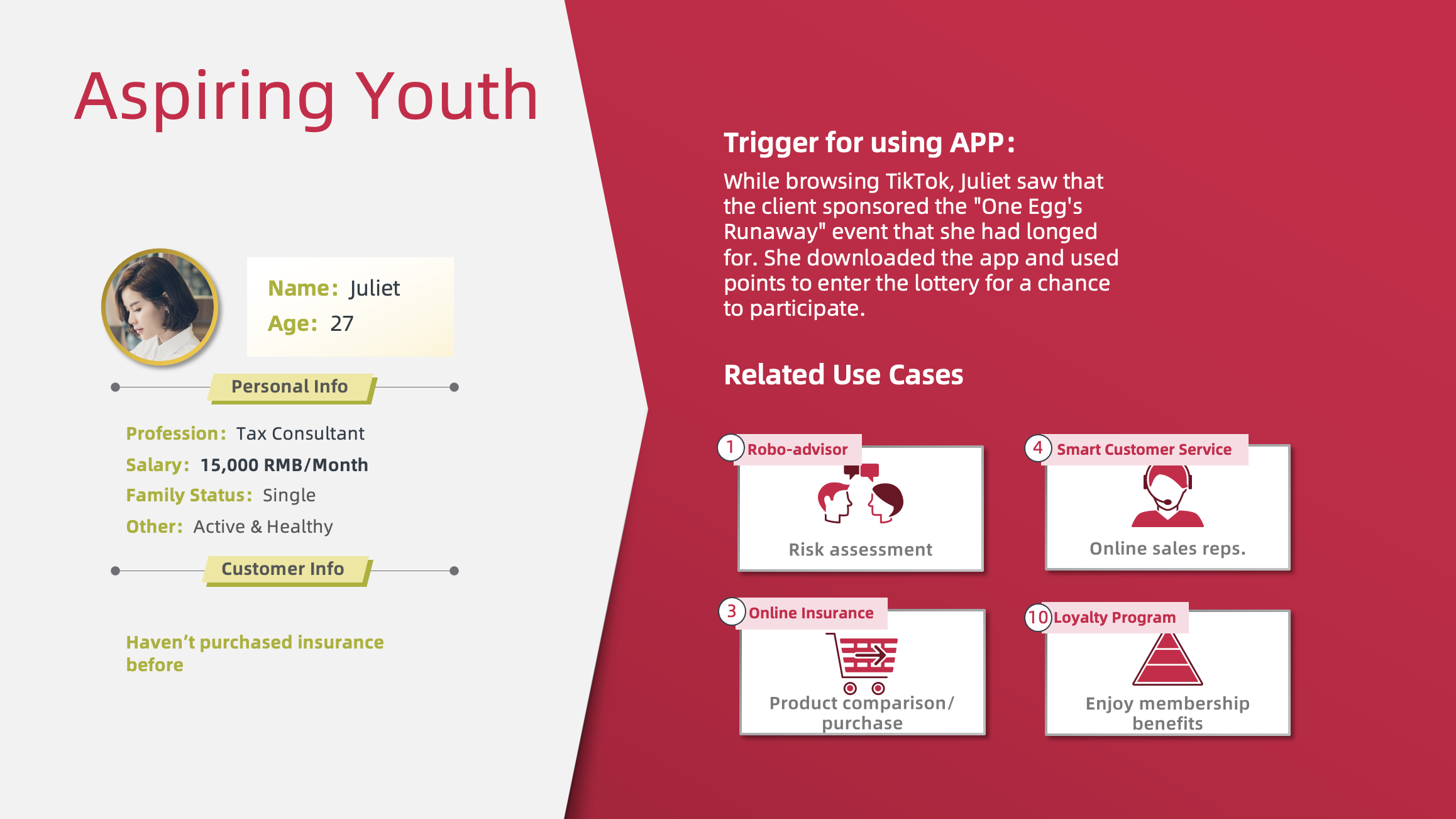
We developed wireframes to visualize the core use cases. The example below for the "Aspiring Youth" persona highlights four key scenarios: robo-advisory, smart customer service, online insurance purchasing, and the loyalty program.
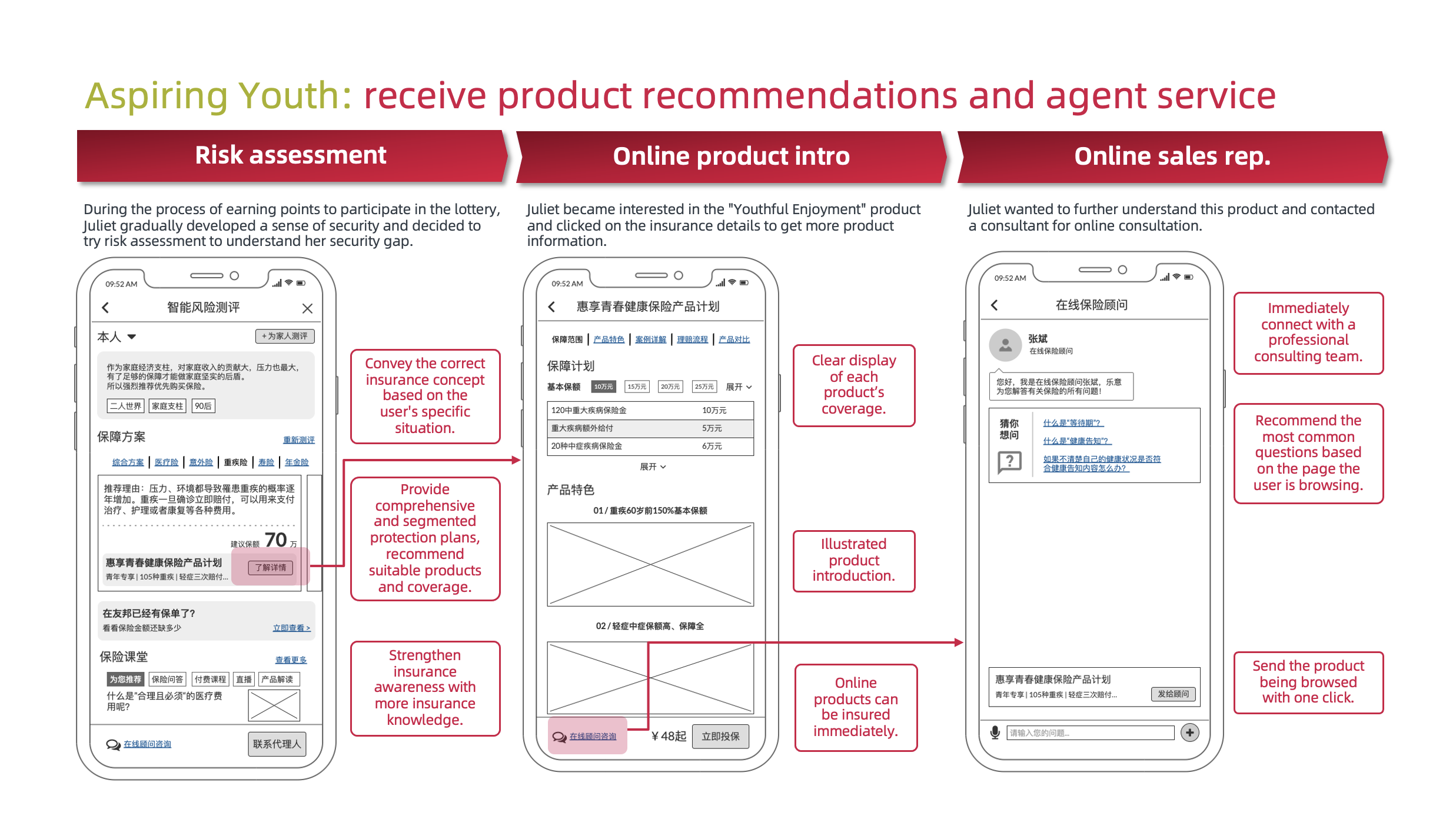
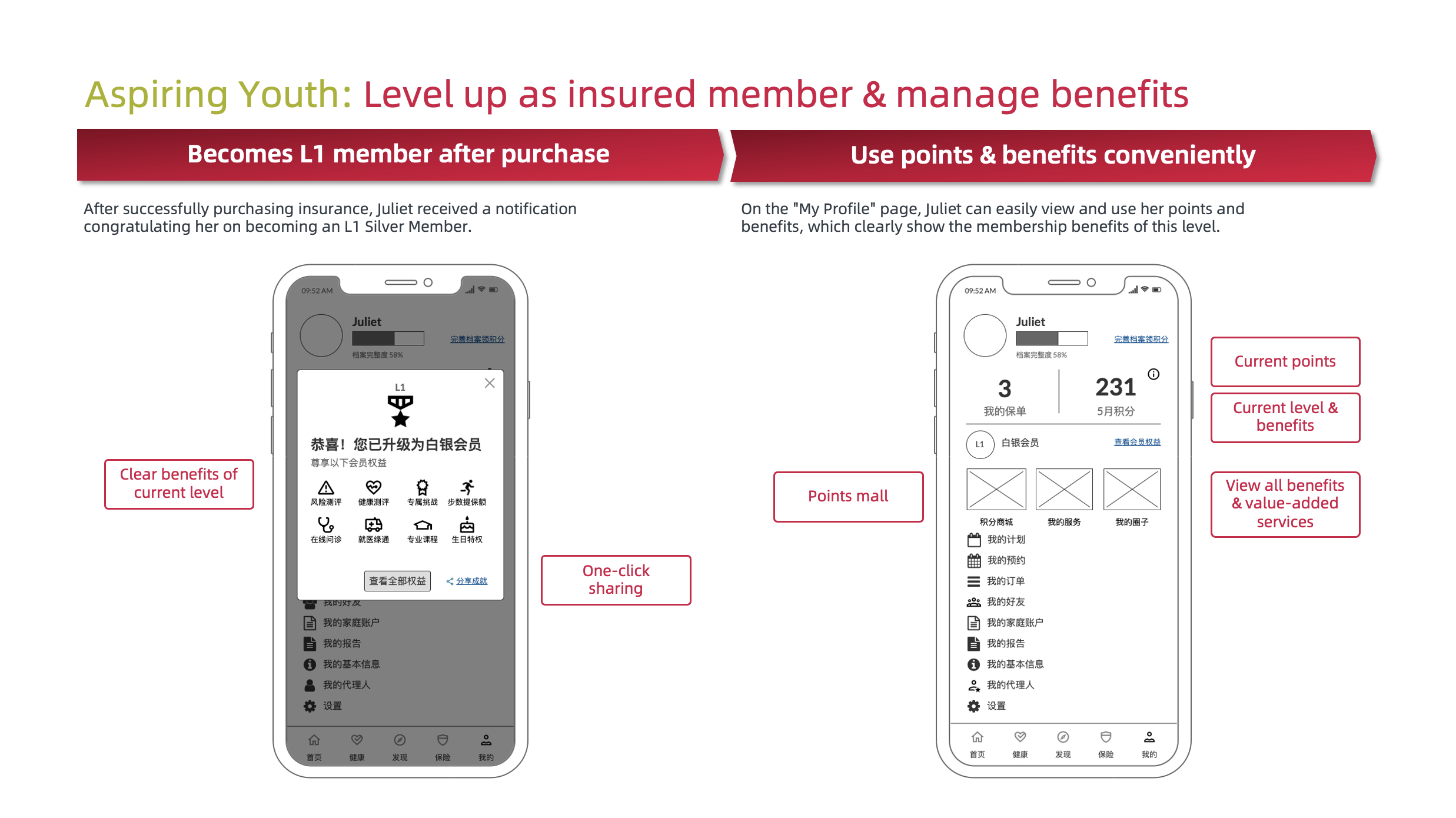
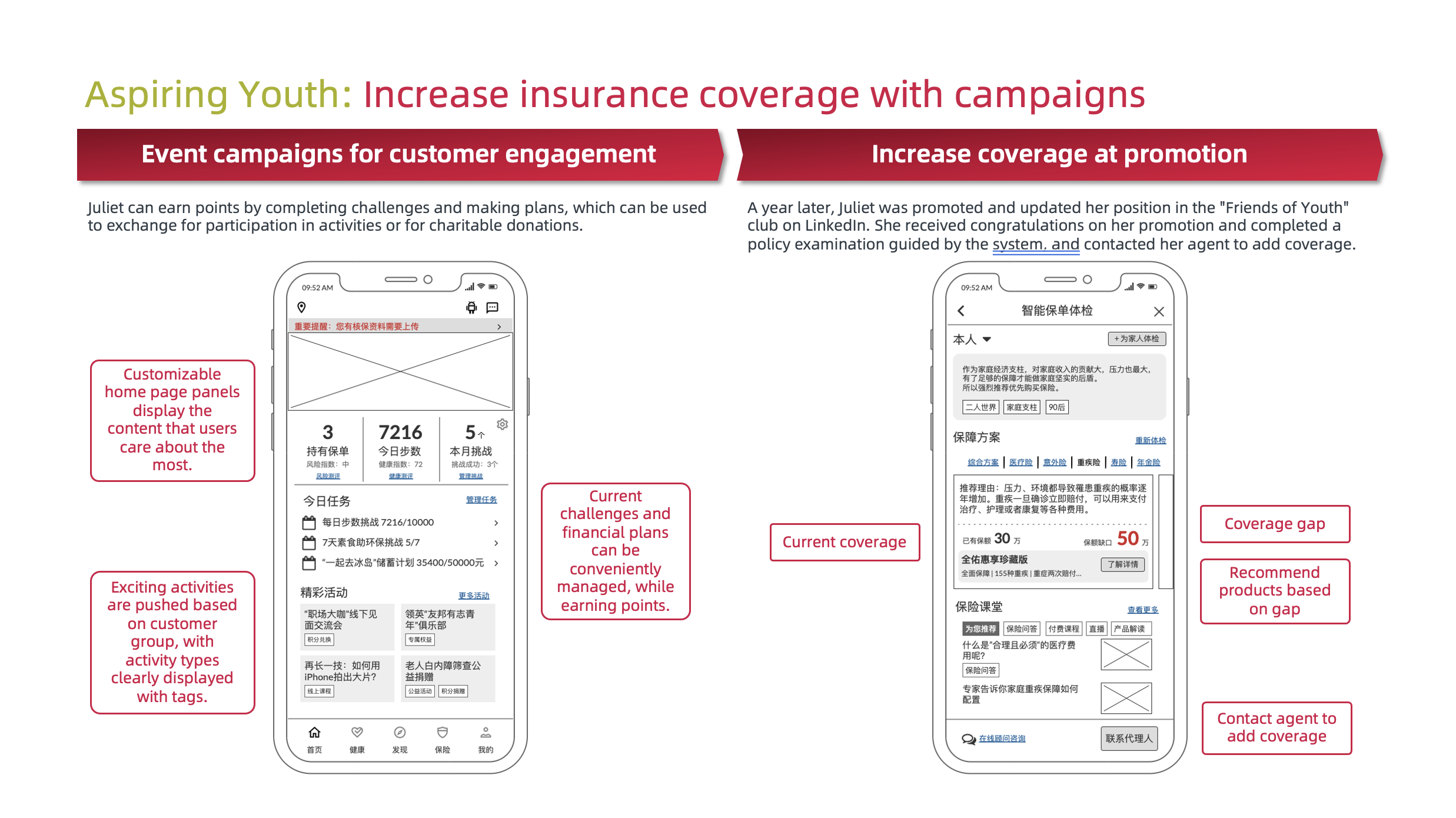
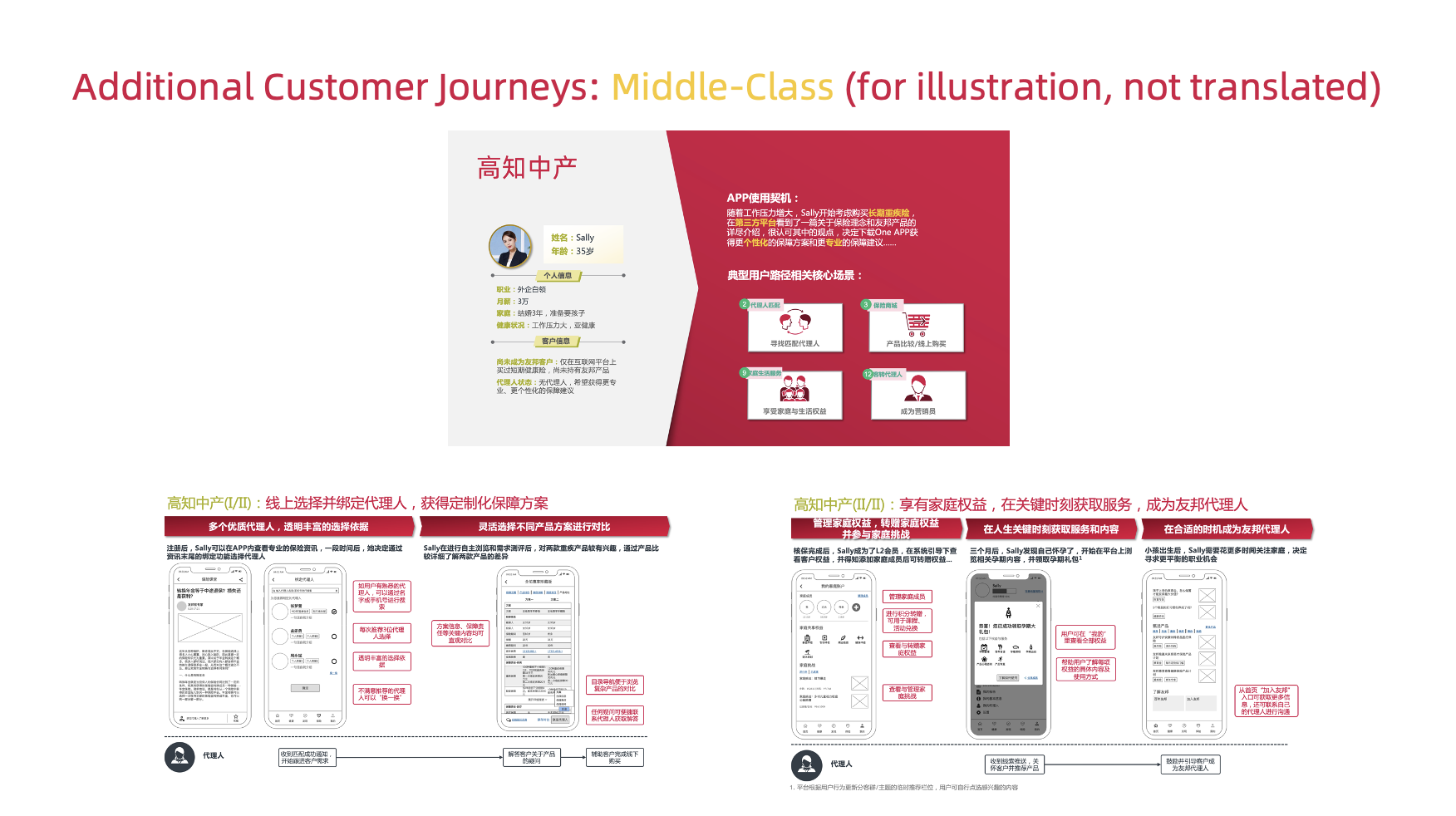
This concluded Phase 2 of the project. We then transitioned into Implementation Planning, outlining a comprehensive project roadmap for the client. After delivering all design artifacts, the client engaged a third-party development team to build the new app experience. By the time of writing, the newly launched app has garnered over 60,000 ratings on the Apple App Store, achieving a 4.8 rating—a significant improvement from the previous app's 3.3 rating.
Project Reflections
A key responsibility of mine was ensuring the user research phase stayed on schedule to avoid delaying parallel workstreams. To mitigate this risk, I facilitated alignment meetings between the client and our vendor to finalize the research plan. I broke the research phase down into specific tasks with measurable outcomes and closely tracked all deliverables. As a result, we successfully collected comprehensive, high-quality research data within the strict timeframe.
Another significant challenge was designing a product capable of serving diverse customer personas. We tackled this by mapping out the commonalities and key differences among our target groups. Recognizing that different personas preferred different blends of online and agent-assisted services, we intentionally designed the ecosystem to support seamless transitions between digital and personal touchpoints at any stage of the journey.
Finally, we had to ensure that the proposed app features could be realistically implemented using the client's existing resources, all without alienating their current user base. We navigated this by hosting cross-functional workshops with the client's internal teams to assess technical and operational feasibility. Furthermore, we validated our designs through testing with both existing customers and internal employees to ensure the final solution delivered genuine value.